Support
EXO instruments are used in numerous applications worldwide. Browse the support section for documentation on your equipment, gain insight and best practice tips from YSI application engineers, and increase your knowledge base.
EXO Advanced Water Quality Monitoring Platform Catalog
Hochleistungsystem zur Überwachung der Wasserqualität
Français - Plate-forme Perfectionnée pour le Suivi de la Qualité des Eaux
Español - Plataforma Avanzada de Análisis de la Calidad de Agua
EXO Preventive Maintenance & Training Programs
Chlorophyll and Blue-green Algae Measurement Combined in EXO Total Algae Sensor
EXO Marine-Grade Materials
Quick and Easy Calibration with EXO Sonde and KOR Software Features
EXO Antifouling Capabilities - Long-term Deployment in Estuarine Conditions
EXO and 6-Series Sensor Comparison
KOR Software January 2013 Release
NASA Undersea Exploration Sets the Stage for Outer Space
KOR Software October 2012 Release
EXO Storage Solutions Guide
KOR Software April 2013 Release
A Closer Look at fDOM Measurement: Reference List
Next Generation of CTDs Just Got Smaller, Smarter, and Tougher
Water-Quality-Monitoring-Made-Easy-Webinar-Notes
EXO Sonde FAQs
• What kind of batteries should be used in an EXO sonde?
The EXO1 Sonde uses two (2) D-cell alkaline batteries and the EXO2 Sonde uses four (4) D-cell alkaline batteries as the recommended power source. Alternatively, the sonde may use rechargeable NiMH D-cell batteries that you purchase. Ni-Cad rechargeable batteries and/or lithium cell batteries should not be used in an EXO sonde. These batteries can damage the sonde's electrical components over time and void its warranty.
• Why are titanium sensors better; are there any cost issues to repairing them?
Titanium sensors stand up to higher pressures underwater, so the EXO sonde can go to 250-meter depths. The strength of titanium also allowed us to reduce the size of all sensors, giving the user room to add more sensors on a smaller-diameter instrument.
Finally, with titanium the EXO optical sensor is completely sealed, eliminating the wiper shaft as a possible leak area in need of repair. Therefore, repairs are likely less required and lifetime ownership cost is improved.
• Can the same EXO sonde be used in both fresh and salt water environments?
Yes, EXO sondes are flexible and can sample and monitor both fresh and salt water with some minor exceptions. The sondes themselves are accommodating to both environments, but some varieties of sensors are compatible only with fresh water. ISE sensors that monitor Nitrate, Ammonium, and Chloride readings are the exception and should not be used in salt water upon their product release. (EXO's ISE sensor line has not yet been released for orders, and interested customers can expect their release in the near future.)
• What is the depth range of EXO sondes?
Overall, EXO sondes have a depth range of 0-250 meters, but it is important to clarify that a sonde will be configured for a particular depth range prior to shipment. Customers must select from the following ranges: No Depth, 0-10 meters, 0-100 meters, & 0-250 meters. When selecting the appropriate sonde, users should understand that sondes equipped with longer depth ranges have looser depth sensor accuracy specs than those with shorter ranges. Additionally, if a sonde is used in an inappropriate depth, the depth sensor will be damaged.
For specific depth sensor accuracy specifications, please refer to the EXO manual or EXO brochure.
• How frequently can EXO sondes log data?
The sampling rate for EXO sondes can be set to 4 Hz (4 times per second), demonstrating their enhanced sampling capabilities as compared to past generation equipment.
• What anti-fouling technology is available for EXO sondes?
As a large number of sondes are used within a continuous monitoring environment, the EXO product line targeted biofouling issues head on. With the EXO2 sonde, users can utilize a new central wiper system that attaches directly to a universal sensor port. The addition of this external wiper can easily net users an additional 25% longer deployment in the field. Furthermore, the sondes themselves are crafted from the most durable of materials.
For more information on EXO's anti-fouling technologies and design, visit:
EXO Rugged Materials [PDF]
Estuaries EXO Antifouling Features [PDF]
• Why do EXO sondes require a USB adapter, rather than having the USB built in?
With rapid advances in technology, it is important that the EXO line remain flexible to meet changes in communication ports. Thus, EXO sondes, like the 6-Series, require adapters for communication to a PC. This solution enables the platform to transcend current technologies and gives users the confidence that EXO sondes will remain up-to-date with advancements to communication port technologies in the years to come.
• What features do EXO sondes have to improve the calibration process?
The EXO platform has several enhancements to the calibration process. These enhancements include smart sensor technology, allowing calibration data to be stored within the sensor itself rather than the sonde. This, along with the ability for EXO sensors to be interchanged using the sondes' universal ports, allows users to calibrate several sensors of one type simultaneously for use in multiple sondes. Ultimately, these changes save both time and money for users due to reduced reagent and labor cost.
For information on other improvements to the calibration process, read the EXO-Calibration-Features document.
• What is the battery life of the EXO1 or EXO2 sonde when used in continuous sampling?
Battery life is heavily dependent on temperature, sensor payload, and the utilized sampling interval. The EXO1 & EXO2 sondes can sample at 15-minute intervals for around 90 days at 20°C while using the following sensor configuration:
EXO1 Example:
Temperature/Conductivity Sensor
pH/ORP Sensor
DO Sensor
Turbidity Sensor
EXO2 Example:
Temperature/Conductivity Sensor
pH/ORP Sensor
DO Sensor
Turbidity Sensor
fDOM Sensor
Total Algae
Anti-fouling Wiper
• Are the data generated from EXO products comparable with data from my 6-Series sonde?
EXO sensors have accuracy specifications that match and surpass their 6-Series counterparts. Furthermore, EXO sensors have improved sensor response times. Customers currently using a 6-Series sonde can easily shift to an EXO product, knowing that their data will transition smoothly, provided that you use the correct calibration values.
For more information on comparing EXO sensors to the 6-Series, please refer to the EXO-6Series-Sensor-Comparison document for more information.
• How fast can I transfer my data to a desktop PC?
The EXO sondes have two methods to transfer data to a PC from a handheld or the sonde itself—by Bluetooth and by USB connection. Utilizing a USB, transferring 1000 data samples takes approximately 21.4 seconds to transfer from sonde to PC, while Bluetooth data transfer takes about 26.3 seconds.
• What are the dimensions and weights of the EXO1 & EXO2?
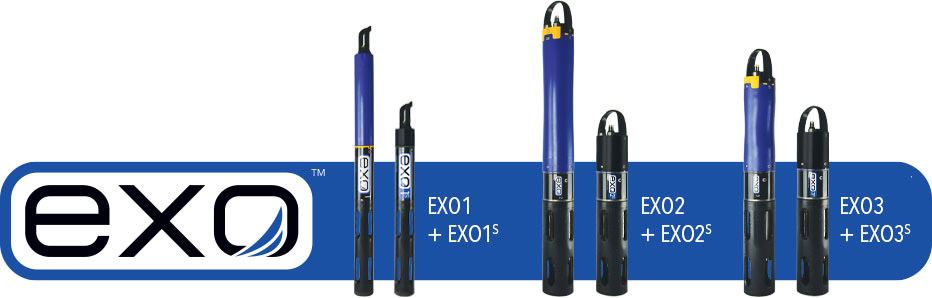
The EXO1 sonde has a diameter of 4.70 cm (1.85 in), a length of 64.77 cm (25.50 in), and weighs approximately 1.42 kg (3.15 lbs.) with batteries and typical sensor payload.
The EXO2 sonde has a diameter of 7.62 cm (3.00 in), a length of 71.10 cm (28.00 in). It weighs approximately 3.60 kg (7.90 lbs.) with batteries and typical sensor payload.
Visit exowater.com/sondes to view interactive 3D models of the products, if you would like a visual perspective.
Communication with a submerged sonde requires a field cable. You cannot communicate with the EXO sondes with Bluetooth while underwater. To utilize Bluetooth, the black EXO label must be out of the water, as it contains the integral radio and antenna for Bluetooth to function properly. When out of the water, the Bluetooth technology has a nominal range of 10 meters (~30 feet).
KOR Software FAQs
• What is SmartQC and how does it work?
SmartQC is a new feature of the KOR software that makes calibration simple. After calibrating a pH/ORP sensor, for example, the KOR software will provide a printable calibration summary form displaying information ranging from sonde/sensor ID numbers to pre/post-calibration values. On this summary, there is also a SmartQC score to determine the success of the calibration. This score is represented by a straightforward, color-coded system. For successful calibrations, a green checkmark will appear on the calibration summary form, while unsuccessful calibrations will receive a red X. Should a calibration fall slightly outside the appropriate score, SmartQC will identify the situation to users via a yellow, caution icon.
• What are the minimum requirements for my PC to run KOR software?
To successfully run KOR software, computers will require the following:
- Windows®XP (service pack 3) or newer Windows operating platform (Windows®7 recommended) 32-bit or 64bit
- Microsoft .NET (any version from 2.0 through 3.5 Service Pack 1)
- 500 MB of hard disk space (1 GB recommended)
- 2 GB of RAM (4 GB recommended)
- Screen with resolution of 1280x800 or greater
- Available USB 2.0 port
- Internet access for software updates
- Optional: Integral Bluetooth or USB dongle Bluetooth adapter
• If I upgrade a 6-Series sonde for an EXO, will my historical data files be compatible?
No, EXO data is recorded in a different file format, but you can still export the data to an outside program (Excel, etc.) to add it to your historical records. For more information about this topic, please refer to the EXO-6Series-Sensor-Comparison document.
EXO User Manual
Comprehensive user manual about operating, calibrating and maintaining your EXO platform with step-by-step instructions and illustrations.
Topics covered include: EXO sondes, handheld, sensors; cables and communication; calibration process and cal standards; installing, using and updating software; collecting data; maintaining and storing equipment; health and safety; warranty; service and repair.
EXO Firmware Update Package - Apr2013
If you experience problems with automatically downloading the latest firmware versions for your EXO
equipment, we recommend you attempt a manual process using this firmware package.
Complete installation instructions. See Troubleshooting info, page 5.
EXO USB Adapter Drivers - Jun2012
Before using the USB Signal Adapter accessory, install KOR software. KOR software contains the required drivers for the USB adapter.
KOR Software for EXO Systems - Apr2013
KOR Software is on a USB flash drive that ships with the EXO systems. Updates to KOR are downloaded here, along with sensor and handheld firmware updates. Updates to KOR for the EXO handheld are accessible through the KOR desktop software menus.
Version 1.0.6 KOR software update provides EXO users new features and additional improvements to the desktop and handheld versions, including:
- Added TDS parameter with output over SDI-12
- Enabled Turbidity NTU in SDI-12 parameter list
- Additional RS-232 commands to SOA-DCP
- Improved accuracy of GPS position data
- Added units options for GPS data to allow exporting to file
- Updated the EXO Handheld dashboard display
Download the Apr. 2013 firmware update along with the Apr. 2013 KOR software release.
Complete installation instructions.
Water Quality Data Collection Made Easy: A Practical Solution for Continuous Monitoring
Original Broadcast: 26thApr2013
Learn how to easily conduct continuous water quality monitoring in real-time by using two new powerful tools: EXO & STORM.
This informative web presentation discusses:
- The benefits of the combined EXO water quality sonde and versatile STORM telemetry solution for remote monitoring
- How EXO can reduce your operations and maintenance costs through longer deployments between servicing
- An "eyes on your data" solution to capture episodes with high-resolution and better manage your water quality program
The EXO + STORM solution makes it easy to do real-time continuous monitoring and share your data via the web. You can set up this plug-and-play solution in under 30 minutes.
Our presenters have years of real-world field experience and will provide examples of actual water quality monitoring stations that have implemented the EXO + STORM solution.
Get More Accurate Estimates of Total Algae Biomass: A New Tool for the Concurrent Measurement of Chlorophyll & Cyanobacteria
Original Broadcast: 29thMar2013
Join us for an informative webinar about the sensor technology, practical-use applications, and calibration of the EXO Total Algae Sensor from YSI.
Tim Finegan, Product Manager, and Brandon Smith, Assistant Product Manager, will discuss topics including:
- Why measuring Chlorophyll & Blue-green Algae (cyanobacteria) together is useful for an accurate estimate of total algae biomass
- Total Algae Sensor technology
- Applications for total algae measurements:
- Eutrophication of surface water
- Coastal algae blooms
- Drinking water reservoirs
- Interferences with TAL sensor
- Calibration and correlation to lab samples
- Q&A
A Closer Look at fDOM Measurement [Rebroadcast]
Original Broadcast: 26thFeb2013
Listen to an informative webinar about measuring colored dissolved organic matter in surface water using YSI's newest smart sensor, fDOM. We discuss topics including:
• What is fDOM?
• How does field fDOM measurement work?
- Details on YSI's EXO fDOM sensor
• Applications for fDOM measurement with EXO, including:
- Augmented sensor suite for enhanced ecosystem monitoring
- Proxy for DOM/DOC/TOC, land-derived nutrients and contaminants
- Light attenuation and primary productivity studies
• Interpreting fDOM data and interferences
• Benefits of combining fDOM with other water quality sensors
New Trends in Environmental Water Monitoring [Rebroadcast]
Original Broadcast: 31stAug2012
Water quality assessment has moved steadily from spot sampling to continuous monitoring—requiring tougher instruments, smarter sensors, and greater ease-of-use in the collection and transmission of data from remote sites. Breaking onto the scene is the new EXO technology for long-term environmental monitoring from YSI. Watch the rebroadcast of an in-depth and informative introduction to the revolutionary EXO instruments and sensors.